

Quick answer: Yes, new authority factoring is real, and factors will fund a carrier in month one, because they underwrite the broker’s credit more than your history. What’s harsher for a new MC is the paper: advance rates as low as 70%, exclusive terms past 12 months, renewal clauses nobody points out, and fees stacked under the headline rate. Here’s what to read before you sign.
Why new authority carriers get the worst paper
It has nothing to do with how you drive. You have no payment history anyone can pull, no reviews, and no track record on the load boards. Brokers say it flatly: some won’t book a new MC at all without a DAT credit score of 90 and posted reviews behind it. From your side of the phone it’s the same wall. No blue check mark, no bookings.
That’s the position you’re negotiating from, and the factor knows it. Ask around about the biggest names and you’ll hear the same two things. Triumph and RTS are the hardest to get approved with, and the first year takes every bit of help you can scrape together to pass underwriting. Some operators get desperate enough to ask whether posting $10,000 to $30,000 in holdings would buy them a spot. When approvals are that tight, whatever contract lands in your inbox starts to look like the only contract.
Then there’s the clock. Brokers pay net 30 to net 60, direct customers push 75 days, and one owner-operator described waiting 60 to 90 days on $50,000 in invoices while the cash dried up. Fuel doesn’t wait for that. So the contract gets signed on a Tuesday afternoon without anyone reading past page two. Start undercapitalized and factoring works like a credit card for fuel and operating expenses. It holds up right until the month it doesn’t.

Do factoring companies actually work with new authority?
They do. Most freight factors underwrite the broker who owes the invoice more heavily than they underwrite you, so a three-week-old MC hauling for a broker with clean credit is fundable. What changes with a new authority is the price and the paper.
What approval looks like in your first 0 to 24 months
There’s no shortcut, and anyone who goes looking for one gets the same answer. Nothing you can pay skips underwriting.
The names that are hardest to join tend to be the ones with the resources. The factors that approve a green MC in a day are the ones operators end up warning each other about later: cheap headline rate, almost no service or communication, and a company that holds you to the exact letter of the contract the moment you try to leave early.
Underwriting runs on your customers as much as on you. A broker can be approved when you book the load and downgraded by the time you deliver it, which is exactly the scenario carriers get burned on. Ask that question directly before you sign: if a customer is good to factor at pickup and not at delivery, who eats that invoice?
What terms look worse when the authority is new
Expect some combination of these:
- An advance rate as low as 70% to 80% instead of the 90-plus you see advertised, with the rest held back as reserve
- A reserve holdback of another 5% to 6% on top of the fee itself
- A higher rate on any customer with net 60 terms, since the factor waits longer for its money
- A longer exclusive term, with 12 months as the common floor rather than the ceiling
Run the math on your own numbers, because the percentage sounds small until you annualize it. Work it the way operators on the boards work it and a 3% fee on a 60 day invoice comes out around 18% a year. At 2% on a faster cycle, closer to 24%. Factor $100,000 a month at 2% and that’s $24,000 a year, taken off your top line, not your margin. Ten years of that, as one veteran totals it up, is the price of a truck.
The fine print to read before you sign
Print the agreement. Sit down with a pen. Five places to slow down.
“Non-recourse” usually isn’t
The people who have already been charged back are blunt about this one. Don’t take the non-recourse pitch at face value. If the customer doesn’t pay, expect the invoice charged back to you. Every factor does chargebacks, because none of them are in business to absorb a broker’s bad debt for free. Recourse agreements say so outright: the bad debt is yours. Non-recourse agreements usually cover one narrow kind of nonpayment and carve out everything else.
Get these answers in writing before you sign:
- Every condition under which a funded invoice comes back to me
- How many days after funding you can charge it back
- Whether you can pull that money from a different invoice or from my reserve
- What happens if the broker pays late but does pay
Add one more. One factoring client got an email saying their factor had filed a claim on a broker’s bond, over a load delivered 90 days earlier, with no prior notice that the invoice was even unpaid. Ask what your factor is allowed to do on your invoices without contacting you first.
Term, renewal, and what it costs to leave
The lock-in comes in three shapes, and most agreements use at least two: an exclusive term longer than 12 months, a minimum amount of receivables you have to fund every month, and a penalty for terminating before the term is up. The big-name agreements have a reputation for being the stickiest. Operators spend a year telling anyone who asks that they’re leaving the day the term expires, then keep running loads through a factor they stopped trusting, because the exit fee costs more than staying.
It gets worse as you grow. The contract that felt fine with one truck becomes the thing standing between you and better terms at five. Factors also get sold. One built up its book, sold out, and its clients’ agreements went along with the sale.
Before you sign, write down five numbers from the contract: the initial term in months, the notice window in days, the exact date the renewal clock starts, the termination fee formula, and the minimum monthly volume plus what you’re charged for missing it.

Fee stacking under the headline rate
The complaint that comes up most: a low advertised rate with a stack of fees underneath it. The percentage you were quoted is one line on the statement.
Ask for the complete fee schedule as a document before you apply. The charges that catch new operators:
- A setup fee over $500 before a single invoice funds
- An escrow requirement, which some factors have and plenty don’t
- A surcharge every time you take same-day funding, so the fast pay you signed up for costs extra on each use
- A minimum monthly funding commitment, plus whatever you’re charged in the month your truck sits in the shop
Two more worth asking about directly, because they hit per transaction: what a wire or an ACH costs you each time you move your own money, and whether the fuel card carries loading fees or per-swipe deductions. A verbal “we don’t really charge that” is worth nothing in month seven. Get the schedule in writing and keep it with the contract.
The UCC lien and the loan you can’t get in year three
Your factor files a UCC-1 against your receivables. That’s normal, and it’s their collateral. The problem shows up later, when you go for an SBA loan or equipment financing and the lender wants a position the factor won’t give up. That exact situation, a lien filing plus a factor unwilling to work around it for an incoming lender, is what turns an otherwise workable factor into one operators tell each other to avoid.
Four questions to ask before signing:
- Does the filing cover receivables only, or all business assets?
- Will you subordinate or carve out for an equipment or SBA lender, and under what conditions?
- How long does that take, and what does it cost?
- How many days after termination and payoff do you file the release?
What happens when a broker stiffs you
This is where new carriers find out what “reserve” and “cross-collateralization” mean in practice. What that looks like:
- Everything freezes, not just the bad load. One fleet had a factor hold all incoming funds until the broker agreed to a payment plan, and went days with no money moving.
- The wait runs 30 to 60 days. Others sat that long on funds from defaulted loads before the factor would arrange any alternative.
- You get blamed before you get numbers. One operator was pushed to accept responsibility for the loss before anyone would give them a full accounting of it.
Ask whether unrelated invoices can be held because of one bad debt, and get the answer in an email, not on a call.
Before you sign anything, find these three clauses
You don’t need a law degree this week. You need to find three specific clauses in the agreement sitting in front of you and understand what each one does to your money and your control.
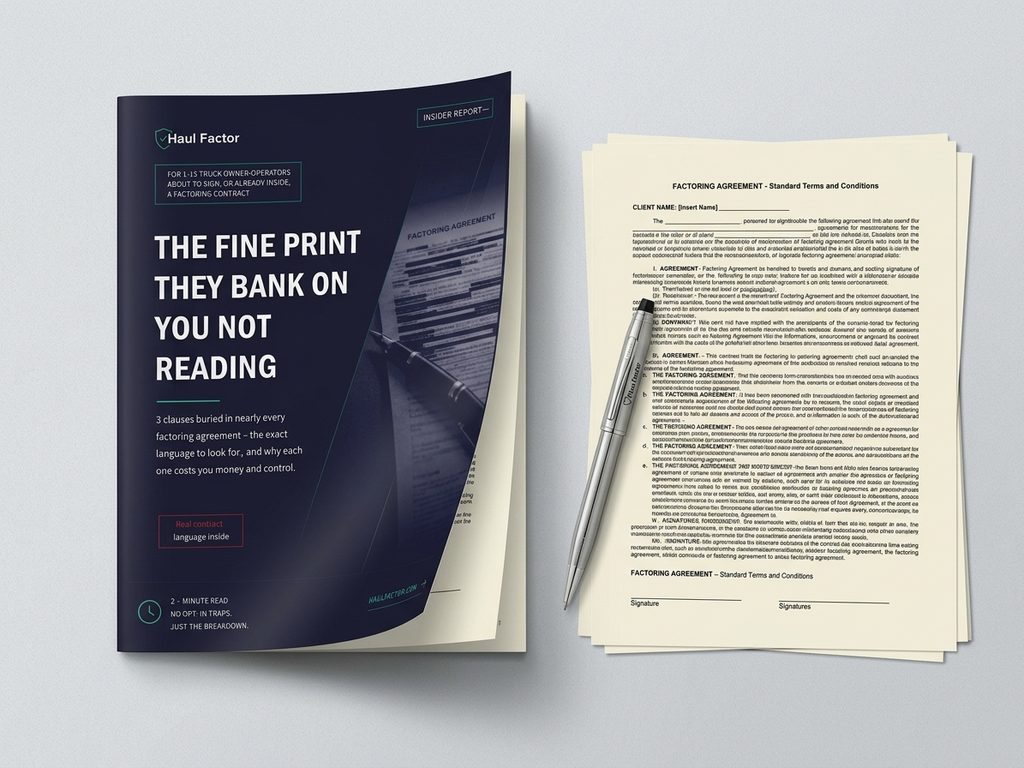
That’s what our report covers. The Fine Print They Bank On You Not Reading walks through the three clauses buried in nearly every factoring agreement, the exact language to look for, and why each one costs you. Two minute read, no opt-in traps, just the breakdown.
How to screen a factoring company before you sign
Ask for the full agreement and the fee schedule before you apply, not after approval. A factor that won’t send the paperwork until you’re committed is telling you something about the paperwork.
Run the agreement through an AI tool and have it pull every fee, penalty, and notice deadline into a list. Operators do this now and it takes about ten minutes. Then put the termination and lien sections in front of an attorney. That’s the advice every burned operator gives afterward, and it costs less than the exit fee you’d be arguing about later.
Discount the YouTube reviews. At least one of the big factors pays creators for referrals, so a chunk of what you’re watching is a marketing contract with a friendly face on it.
Ask who you call when a payment isn’t applied, and who that person escalates to. Support sits offshore at some factors, with no route to anyone who can make a decision and a standard answer that there’s nobody else to speak with. Get a name and a backup name while you’re still a prospect.
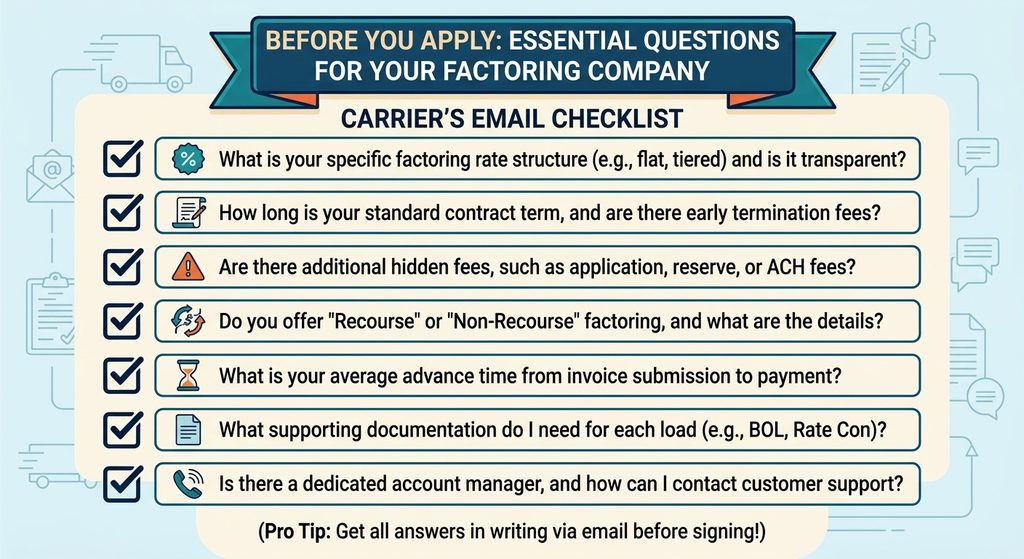
Ask what happens when they mishandle your paperwork. Some factors accept a submission without checking it, then leave the invoice sitting three weeks late in their own system while you wait on money you already earned. Others send invoices to the wrong brokerage and never follow up on missing documents. Ask who catches that, and how quickly.
What Haul Factor screens for
We screen freight factoring companies on behalf of small fleets, and every lender on our bench has to meet the standard we publish as the 4-Point Fleet Shield before we refer a single carrier to them.
- 15-Minute Speed-to-Lead SLA. Matched lenders must contact you within 15 minutes or the file auto-reassigns.
- Zero Fuel Card Surcharges. No hidden load fees or per-swipe deductions.
- No Surprise Auto-Renewal. Any renewal terms are disclosed in writing before your first invoice funds.
- Capped Wire & ACH Fees. Flat-rate, transparent transfer costs.
Point three is the one that matters most at your stage. The claim isn’t that renewals never happen, because most factoring agreements renew. The claim is that no renewal term shows up as a surprise after your money is already inside the relationship. A factor that breaks one of these after a referral comes off the bench.
Still holding an unsigned contract?
The clauses that cost you are in there whether you read them or not, and the exit fee only starts mattering after you’ve signed. Find the three that matter first.
When you’re ready to see who’d actually fund you
No rush on this one. Read the report, ask the questions above, and put whichever factor you’re talking to through them. When you want to see which lenders would fund a carrier at your stage under terms that pass our screen, the check takes about a minute.
See which factors pass the screen
The contract you sign in month three is the one you’re still operating inside in month twenty-three, when you have volume, maybe a second truck, and a shot at an equipment loan. All of that runs through paper you signed while you were worried about making a fuel payment on Friday. Read it now, while walking away is still an option.