
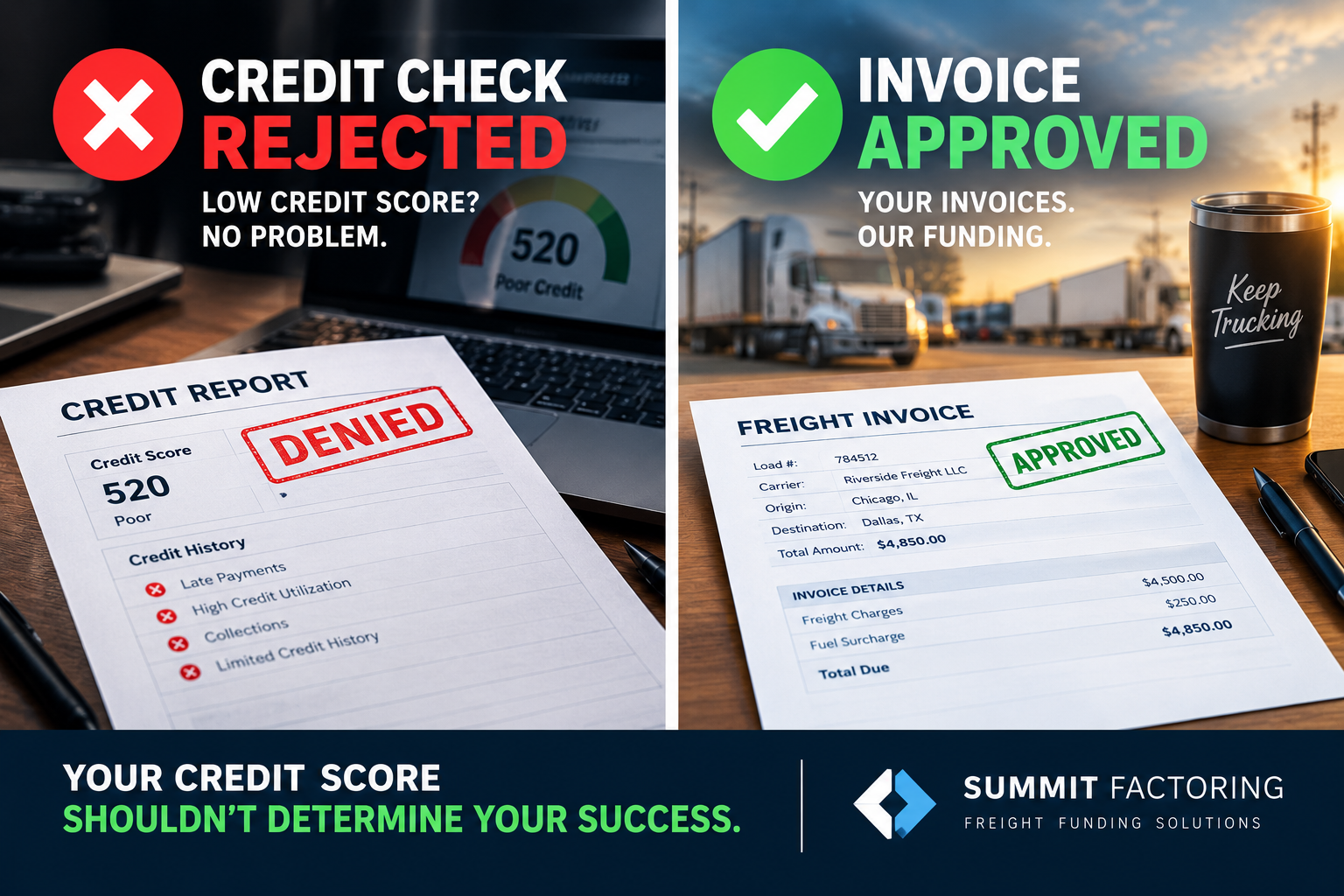
Most freight factoring gets approved on your customer’s credit rather than yours, which is why no credit check is standard language in this industry rather than a warning sign. It doesn’t mean nothing gets looked at. Your authority, the brokers on your invoices, and any lien a previous factor left behind all get checked, and the difference between a legitimate offer and a predatory one shows up in the paperwork rather than the pitch.
Why most factoring doesn’t run on your credit score
Your customer’s credit is the collateral
A factor isn’t lending you money against your name. They’re buying an invoice you already earned, at a discount, and the risk they’re pricing is whether the broker on that invoice pays.
That’s why underwriting looks where it does. The factor checks the broker’s credit, because the broker is the one who owes the money. Your score doesn’t tell them anything about whether a $2,400 load pays out in 30 days.
There’s a second reason the model works without your credit. When a customer doesn’t pay, the invoice usually comes back to you as a chargeback, which caps the factor’s exposure. Operators put it plainly: no factor is in business to absorb a broker’s bad debt for free.
What that means if your credit is thin or damaged
A business that failed in 2019 has no bearing on whether a broker pays an invoice you delivered last Tuesday. That’s the whole reason “no credit check” is honest language for most of this industry.
What it doesn’t mean is that approval is automatic. Getting set up with a factor takes real underwriting, there’s no fast path around it, and the biggest names are the hardest to get approved with. Operators trying to break into Triumph or RTS ask around for shortcuts and get told the same thing every time: there aren’t any. Some go as far as asking whether posting $10,000 to $30,000 in holdings would buy them a spot.
Approval hinges on your paperwork and your customers. Not your FICO.
What “no credit check” doesn’t mean
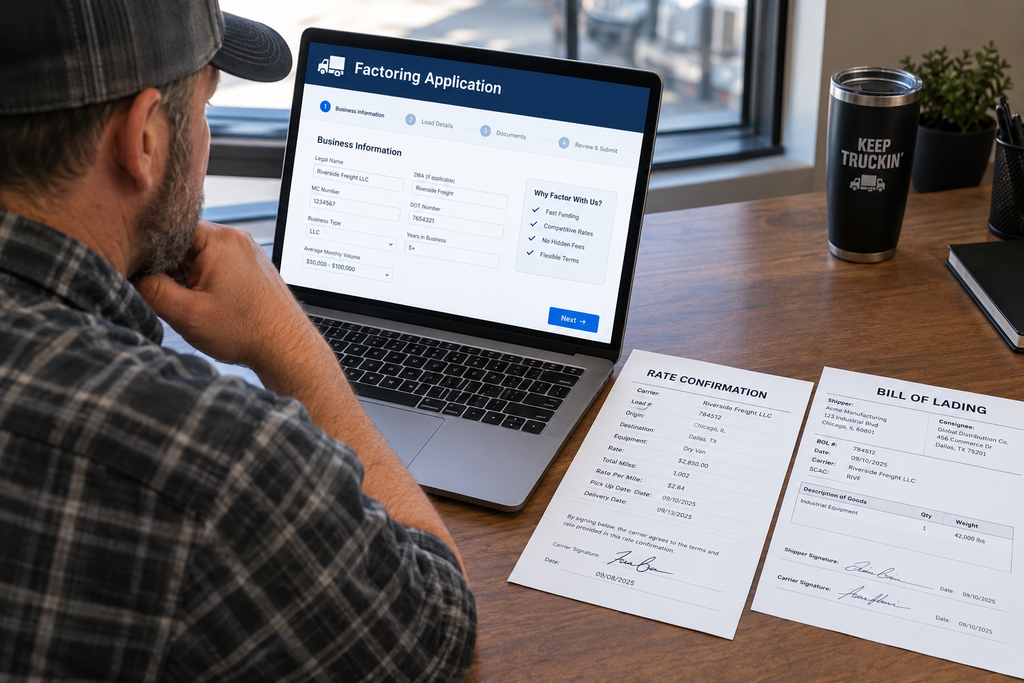
The phrase describes one specific thing: no personal or business credit score gets pulled to approve you. Three other checks happen anyway.
Your authority and how long you’ve had it
Time in operation matters even when credit doesn’t. Operators say the first year takes every bit of help you can scrape together to get approved anywhere decent.
The same wall shows up on the freight side. Some brokers won’t book a new MC at all without a DAT credit score of 90 and posted reviews behind it, which means a brand-new authority can be short on both the customers and the track record a factor wants to see.
The customers you plan to factor
Send over a list of brokers you haul for and the factor will run each one. Some get approved at a lower rate, some at a higher rate because they pay on net 60 terms, and some get declined outright.
That approval isn’t permanent either. Carriers describe being told a broker is good to factor, then watching that broker’s rating change before the load delivers. Ask what happens to an invoice caught in that window, and ask before you sign, since the answer depends on whether your agreement is recourse or something the factor calls non-recourse.
Any lien a previous factor left behind
This one surprises people. A factor files a UCC-1 against your receivables when you sign, and that filing has to be released or subordinated before a new factor will fund you.
If your last factor is slow to release it, or unwilling to work around it, your next application stalls regardless of how clean your credit is. Carriers describe exactly that problem with lien filings blocking a new lender, and it’s the reason they warn other operators off companies they were otherwise fine with.
New to factoring altogether?
If you’re still working out the mechanics, the advance, the fee, the reserve, and what the factor does after you send the invoice, start with the full walkthrough of how freight factoring works and come back to this page. The rest of this piece assumes you know how the money moves.
How to tell a legitimate no-credit-check offer from a predatory one
Both kinds advertise the same phrase. The difference is in what sits underneath it.
The reputation problem is real, and it exists because nobody screens the people selling this product. “No credit check” is an easy headline to run when the carriers reading it are assumed to have no other options. Three places to look.
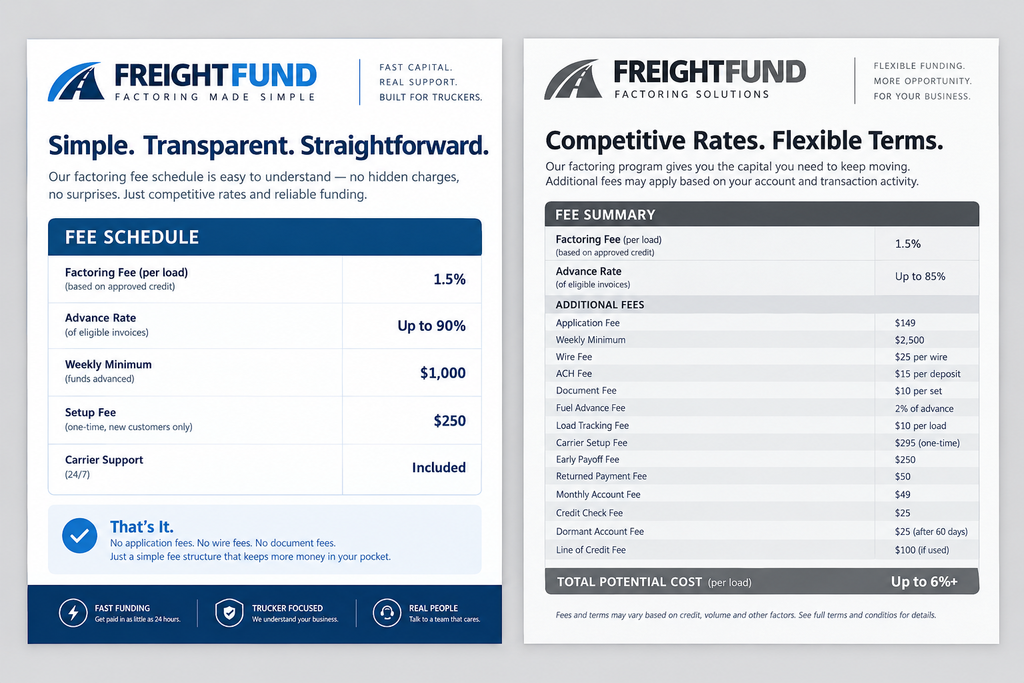
The fee stack under the headline rate
The complaint that comes up most: a low advertised rate with fees layered underneath. What to ask for in writing:
- The fee itself. Most carriers see 1% to 3% of the invoice. Anything at 4% gets called a scam outright by operators who have shopped around.
- The advance rate. Advertised numbers run high. Real ones run as low as 70% to 80%, with the rest held back as reserve.
- The reserve holdback. Another 5% to 6% on top of the fee at some factors, with no clear date attached to when it releases.
- Setup and escrow. Setup fees over $500 before a single invoice funds, plus an escrow requirement at some factors and none at others.
- Same-day funding surcharges. The fast pay you signed up for costs extra every time you use it.
Then run the annualized math, because the percentage sounds small until you do. A 3% fee on an invoice that pays in 60 days works out to roughly 18% a year. At 2% on a faster cycle, operators put it closer to 24%. Factor $100,000 a month at 2% and that’s $24,000 gone in a year, charged on your gross revenue rather than what you actually clear.
That’s the comparison worth making: what this specific offer costs against what it does for you.
Contract length and what it costs to leave
Predatory operators don’t make their money on the rate. They make it on the exit.
Watch for exclusive terms longer than 12 months, a minimum amount of receivables you’re required to fund every month, and a penalty for terminating before the term is up. The cheapest headline rates tend to come attached to the hardest contracts, and carriers describe those factors as the ones who will hold you to every letter of the agreement the moment you try to leave. Some spend a year telling anyone who asks that they’re leaving the day the term expires, and keep running loads through a company they stopped trusting because the exit fee costs more than staying.
What ends up on your record once you’re a client
Here’s the part that catches this audience off guard. Skipping the credit check on the way in doesn’t mean the relationship leaves no trace on your business.
Start with whose name sits on the paperwork. When a factor invoices and collects under its own name, two clean years of payments build a history that belongs to them rather than to your business. That’s one of the three practices our own screen checks for, and it matters most to a carrier trying to build a file from scratch.
Then there’s the UCC-1 filing. It sits against your receivables for as long as the relationship runs, and the next lender you approach for a truck or a line of credit will see it. Ask how fast it gets released after you leave, and whether they’ll subordinate for an equipment lender while you’re still a client.
The third one costs you in time rather than points. A factor that accepts a submission without checking it can leave an invoice sitting three weeks late in its own system. Another sends the invoice to the wrong brokerage and never follows up on the missing paperwork. Ask who catches that, and how quickly.
The clause language covering the filing and the release is specific and repeatable, which is why we keep decoded versions of it in our contract fine print database.
The question underneath the search
Most people who search this phrase are asking one of two things. Will I get rejected, or is a financial product that skips the credit check automatically a trap?
The answer to the first is that your credit mostly isn’t the deciding factor. The answer to the second is what our report covers. Not All Factoring Is A Payday Loan breaks down the three clauses buried in nearly every factoring agreement, the exact language to look for, and what each one costs you in money and control. Two minute read, no opt-in traps.
What Haul Factor screens for
We screen freight factoring companies on behalf of small fleets, and every lender on our bench has to meet the standard we publish as the 4-Point Fleet Shield before we refer a carrier to them.
- 15-Minute Speed-to-Lead SLA. Matched lenders must contact you within 15 minutes or the file auto-reassigns.
- Zero Fuel Card Surcharges. No hidden load fees or per-swipe deductions.
- No Surprise Auto-Renewal. Any renewal terms are disclosed in writing before your first invoice funds.
- Capped Wire & ACH Fees. Flat-rate, transparent transfer costs.
Point four does the most work for a carrier who came in through a no-credit-check offer. Transfer charges land on every payment rather than on the invoice you were comparing, so an uncapped wire fee quietly reprices a deal that looked competitive on the rate sheet. A lender that breaks one of these after a referral comes off the bench.
If you’re new authority and worried about credit
These two things get searched together for a reason. A carrier in the first year of authority has a short credit file, no reviews, and no leverage, and that combination is exactly what predatory terms are built for.
The approval process and the contract terms both look different at that stage, and there’s a longer breakdown of what to check before you sign your first factoring agreement that covers it properly.

Before you take a no-credit-check offer
The offer isn’t the problem. The agreement underneath it might be, and the clauses that cost you are in there whether you read them or not.
When you’re ready to compare offers
No rush on this part. Read the report, ask for a complete fee schedule in writing, and put whichever factors you’re talking to through the same questions. When you want to see which lenders would fund a carrier at your stage under terms that pass our screen, the check takes about a minute and doesn’t touch your personal credit.
See which factors pass the screen
Skipping the credit check is normal in this industry, and it isn’t the thing worth worrying about. What’s worth your attention is the fee schedule, the term length, and what the company puts on your record once your invoices are running through them. Get those three in writing and the rest of the decision gets a lot easier.