

Factoring for owner operators solves one problem: brokers pay on 30 to 90 day terms and fuel gets bought this week. A factor advances most of the invoice within a day of delivery, keeps a percentage, and collects from the broker later. The terms that are merely annoying at ten trucks land differently at one, because there’s less freight to spread a fixed cost across.
The gap this exists to close
You already know the shape of it. The rate con says one number, the broker’s terms say net 30 or net 60, and one operator described waiting 60 to 90 days on $50,000 in invoices while the cash ran out underneath him.
The broker isn’t always the problem either. A broker paid by their customer at 60 or 90 days is floating the same gap, and when the shipper drags, that delay lands on the person who hauled the load. Some brokers simply don’t pay, and operators treat that as a cost of doing business rather than an emergency. If a broker refuses at day 60 and you have no cushion, there’s no second move.
That’s the part that separates one truck from ten. Operators without the reserves to survive 30 to 60 days of waiting don’t have a slow quarter, they have a shop bill they can’t cover and a truck that isn’t earning until they do.
Factoring closes that gap. What it costs to close is the rest of this page.

What changes when you factor at one or two trucks
Same product, different math. At five or ten trucks, a fixed charge gets diluted across the volume. At one, it lands on you at full weight.
Per-transaction fees hit harder when there are fewer transactions
A wire fee, an ACH charge, or a per-invoice processing charge doesn’t scale down because your fleet is small. Run 12 loads a month instead of 120 and the same flat charge is ten times the share of your revenue.
The same logic applies to setup costs. Setup fees over $500 before a single invoice funds are a rounding error on a large book and a real hit on a one-truck operation still buying tires.
The reserve holds back a bigger share of a smaller book
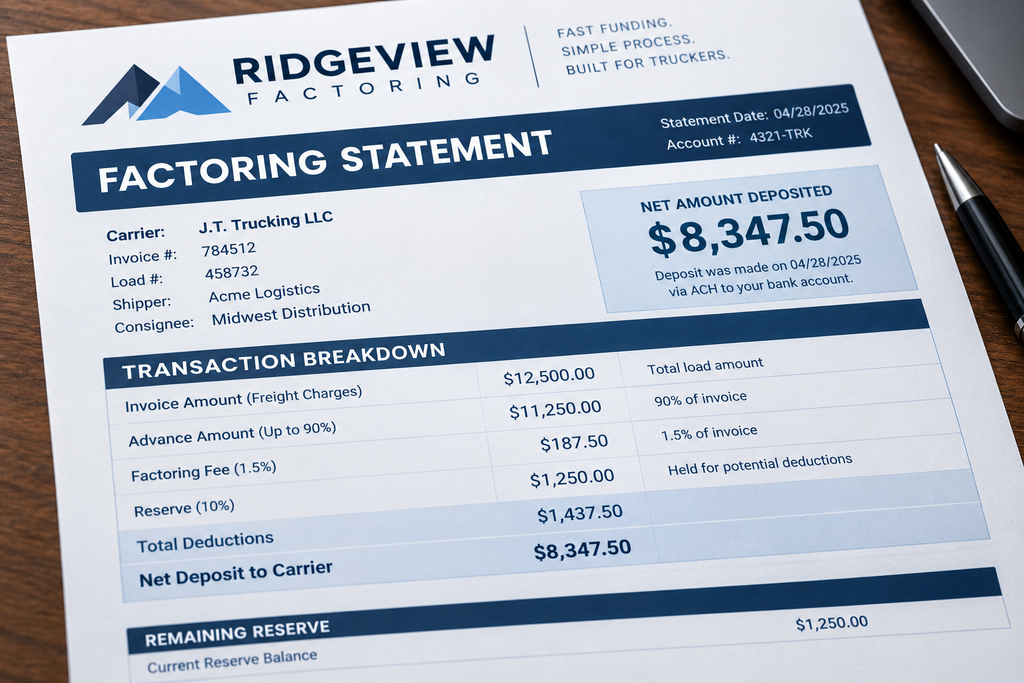
Advertised advance rates run high. Real ones run as low as 70% to 80%, with the rest held back as reserve, and some factors stack another 5% to 6% reserve on top of the fee itself.
At scale, held-back money is an accounting line. At one truck, it’s the difference between covering the next fuel stop and not. Ask when reserve releases and what conditions hold it, because a reserve that clears at the end of the month behaves like a payment delay you didn’t agree to.
Minimum volume commitments punish a slow month
Some agreements require you to fund a minimum amount of receivables, or to keep funding for a set stretch of time. A fleet absorbs that easily. One truck in the shop for two weeks does not.
That’s the clause to find before you sign: what the minimum is, how it’s measured, and what happens in a month you can’t hit it. The specific language shows up in agreements over and over, which is why we keep decoded versions of it in our contract fine print database.
Quick pay and same-day surcharges compound
Factors charge extra for same-day funding, so the fast money you signed up for costs more every time you use it. Pay a larger fee for quick pay and operators report it still ending with a check in the mail, which puts you back where you started on timing while paying for the privilege. Broker quick pay has its own version of the problem, since what it really does is let the broker hold part of your gross.
Split-pay arrangements deserve the same scrutiny. What looks like a lower factoring cost tends to come back out of your margin somewhere else, and carriers describe the split model as the riskier side of that trade.
Still working out the mechanics?
If the advance, the fee, and the reserve are still fuzzy, the full walkthrough of how freight factoring works covers the model end to end. The rest of this page assumes you know how the money moves.
Three things to check that hit differently on one rig
Our third insider report is called Net 30 Isn’t 30 Days, and the three flags it covers land hardest on exactly this scale.
Payment float. Net 30 describes when the clock starts, not when money reaches your account. A check cut on day 30 and mailed is money you see in week six, and quick pay that still arrives as a mailed check does the same thing while charging you for speed. Ask how funds arrive, not just when they’re released.
Sub-100% advance. The gap between the advertised advance and the real one is your working capital. On a $2,400 load, an 80% advance is $1,920 now and $480 sometime later, minus the fee. Multiply that across a month of loads and the reserve is a meaningful share of what you thought you were getting.
No cash cushion. This is the one that turns the other two into a crisis instead of an annoyance. An operator running without reserves can’t wait out a chargeback, a slow release, or a broker who stops answering.
Before you sign anything at this scale
If the invoice timing is what’s squeezing you, the report goes straight at it. Net 30 Isn’t 30 Days walks through the three clauses buried in nearly every factoring agreement, the exact language to look for, and what each one costs you in money and control. Two minute read, no opt-in traps.
The math worth running before you sign
Three calculations, done with your own numbers rather than the ones on the rate sheet.
The fee, annualized against what you actually gross
The percentage is charged on the gross invoice, not on what you clear after fuel, insurance, and the truck payment. A 3% fee on an invoice that pays in 60 days works out to roughly 18% a year. At 2% on a faster cycle, operators put the effective cost closer to 24%.
Run it on your own volume. Factor $100,000 a month at 2% and that’s $24,000 in a year. Anything at 4% gets called a scam outright by operators who have shopped around, and that judgment holds harder on thin margins where there’s nothing to absorb it.
What the reserve costs you in delayed cash
Take the advance rate, subtract it from 100, and that’s the share of every load sitting on the factor’s side until release. Then ask how long release takes.
That number matters more than most rate comparisons. A factor at 2% with a fast release can be cheaper in practice than a factor at 1.5% holding 6% for an undefined stretch.
What a slow month costs against a minimum
If the agreement carries a minimum volume commitment, work out the charge for missing it, then compare that to a realistic bad month. A blown turbo, a DOT hold, a stretch of soft rates with too much capacity chasing too few loads. Any of those can put you under a threshold that looked easy the day you signed.
If the penalty for one bad month exceeds what you’d save on the rate, the cheaper deal isn’t cheaper.
What Haul Factor screens for
We screen freight factoring companies on behalf of small fleets, and every lender on our bench has to meet the standard we publish as the 4-Point Fleet Shield before we refer a carrier to them.
- 15-Minute Speed-to-Lead SLA. Matched lenders must contact you within 15 minutes or the file auto-reassigns.
- Zero Fuel Card Surcharges. No hidden load fees or per-swipe deductions.
- No Surprise Auto-Renewal. Any renewal terms are disclosed in writing before your first invoice funds.
- Capped Wire & ACH Fees. Flat-rate, transparent transfer costs.
Point two carries the most weight at this scale, because you’re the one swiping the card. A per-swipe deduction or a card-loading fee is charged on every fill rather than on the invoice you compared, and at one truck that lands on your fuel budget directly.
There’s a service dimension too. At the biggest factors, a one-truck account is one of thousands, and operators with an issue describe getting treated accordingly. Speed of response is worth checking before you need it.

Two adjacent decisions worth settling first
If your authority is under two years old, approval and terms both look different, and there’s a fuller breakdown of what to check before you sign a first factoring agreement.
The other decision is what happens when a broker doesn’t pay. Recourse means the bad debt lands back on you, which on one truck is the invoice you were counting on for next week’s fuel. The offers labeled non-recourse carry exceptions worth reading closely, and what that label actually covers is its own conversation.
Still comparing offers?
The rate is the easiest number to compare and the least useful one on its own. The timing, the reserve, and the minimum are where a one-truck operation actually wins or loses.
When you’re ready to see who’d fund you
No rush on this part. Read the report, get a complete fee schedule in writing from anyone you’re talking to, and run the three calculations above on your own numbers. When you want to see which lenders would fund a one or two truck operation under terms that pass our screen, the check takes about a minute.
See which factors pass the screen
At one truck there’s no margin for a bad agreement to hide in. A fee you’d never notice across a fleet of fifteen shows up in your fuel budget the same week, and a reserve nobody explained turns into a payment delay you didn’t plan for. Run the three numbers before you sign, the annualized fee, the reserve and when it releases, and the minimum you’re committing to, and factoring does the job it’s supposed to do.