
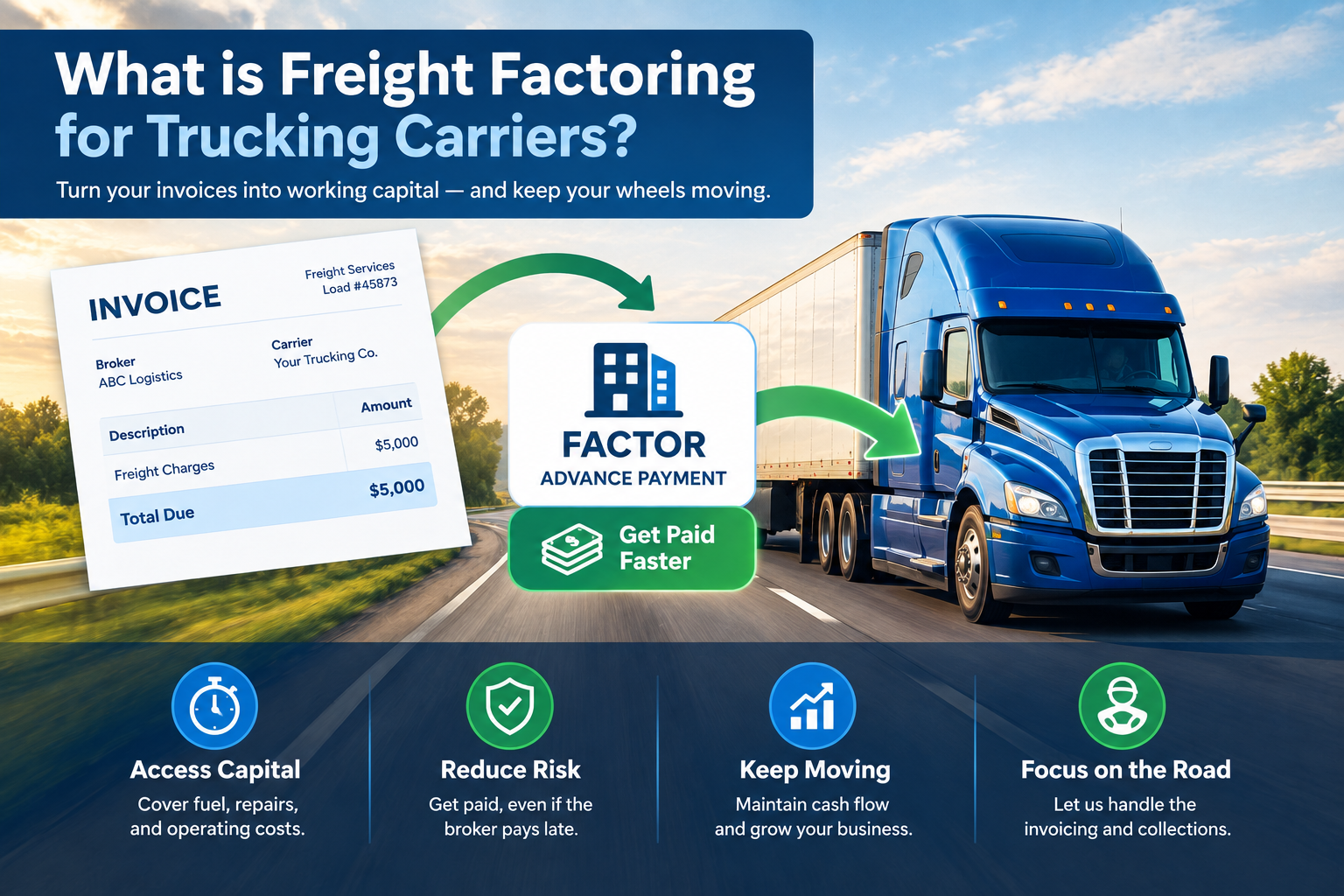
Freight factoring is when you sell an unpaid invoice to a third company, called a factor, for slightly less than its face value. You get most of the money within a day or so instead of waiting 30 to 90 days for the broker to pay, and the factor collects the invoice later. That part is simple, and what most explainers skip is what the agreement does to you after you sign it.
How freight factoring actually works
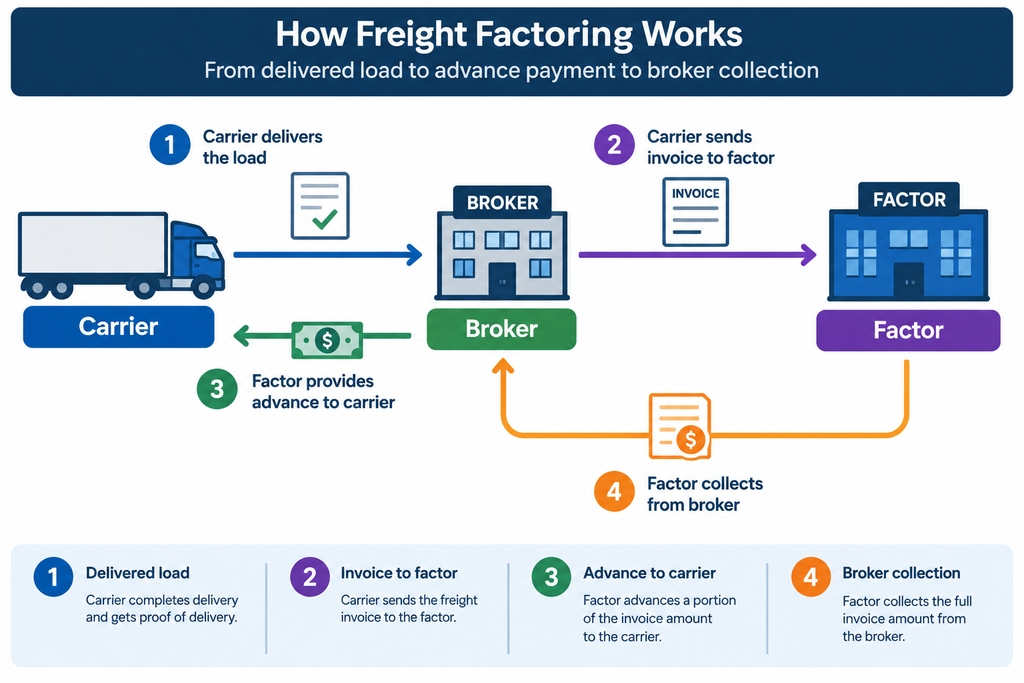
You deliver a load. You send the factor your invoice and the paperwork that proves the load moved, usually the rate confirmation and a signed bill of lading. The factor checks that the broker on the invoice is creditworthy, funds you, and then waits for the broker to pay them.
Three things happen in that handoff, and each one has a number attached.
What you get on day one
You get an advance, which is a percentage of the invoice rather than the whole thing. Advertised rates run high. Real ones run lower. Advance rates as low as 70% to 80% show up in operator accounts, and the gap between the number on the website and the number that hits your account is the first surprise, usually the day you compare the rate sheet to your first deposit.
On a $2,000 load at an 80% advance, that’s $1,600 now.
What the factor keeps
Two pieces. The fee, which runs somewhere between 1% and 3% of the invoice for most carriers. And the reserve, which is the rest of your money held back until the broker pays.
Reserve holdbacks of 5% to 6% sit on top of the fee at some factors. That money is yours, in theory. The question worth asking before you sign is when it comes back and what conditions release it, because reserve is also the pot a factor reaches into when an invoice goes bad.
What happens when the broker pays
The factor collects, keeps its fee, and releases what’s left of your reserve. On a clean invoice with a broker who pays on time, the whole thing works exactly the way the salesperson described it.
The complications start when the invoice isn’t clean, and that’s most of what the rest of this page is about.
Why carriers use it in the first place
Because the money and the bills arrive on different schedules.
Brokers pay on net 30 to net 60. Direct shippers push 75 days. One operator described waiting 60 to 90 days on $50,000 in invoices while the cash dried up. Meanwhile fuel gets bought this week, the truck payment posts on the first, and the driver expects to be paid on Friday.
The brokers aren’t necessarily the villains here. A broker gets paid by their customer at 60 or 90 days and pays the carrier 15 to 30 days after delivery, which means they’re floating the gap too. And when a shipper drags its feet, that delay cascades straight down to the person who actually hauled the freight.
Then there’s the part nobody plans for. Some brokers just don’t pay, and operators treat that as a normal cost of doing business rather than an emergency. If a broker refuses at day 60, a carrier without reserves is out of options.
That’s the gap factoring fills. It’s also why undercapitalized operators end up leaning on it hard. Start out undercapitalized and factor everything, and you’re running fuel and operating expenses on a credit card. Run it that way long enough and it catches up with you.
If you’re inside your first two years of authority, the approval process and the terms both look different, which is worth reading before you apply anywhere.
What it actually costs
“One to three percent” sounds like a rounding error. Run the numbers the way operators on the boards run them and it stops sounding small.
The fee comes off your top line, not your margin
This is the single most misunderstood thing about factoring cost. The percentage is charged on the gross invoice, not on what you clear after fuel, insurance, maintenance, and the truck payment. On thin margins, a fee that looks like 3% of revenue is a much larger share of profit, and it adds up to tens of thousands of dollars a year for a carrier running real miles.
Annualize it and the picture gets sharper. A 3% fee on an invoice that pays in 60 days works out to roughly 18% a year. At 2% on faster cycles, operators put the effective cost closer to 24%. Factor $100,000 a month at 2% and that’s $24,000 gone in a year. Someone who has been doing this a decade will tell you what that adds up to over a career: the price of a truck.
Anything at 4% gets called a scam outright by carriers who have shopped around.
Reserve holdbacks nobody explains on the call
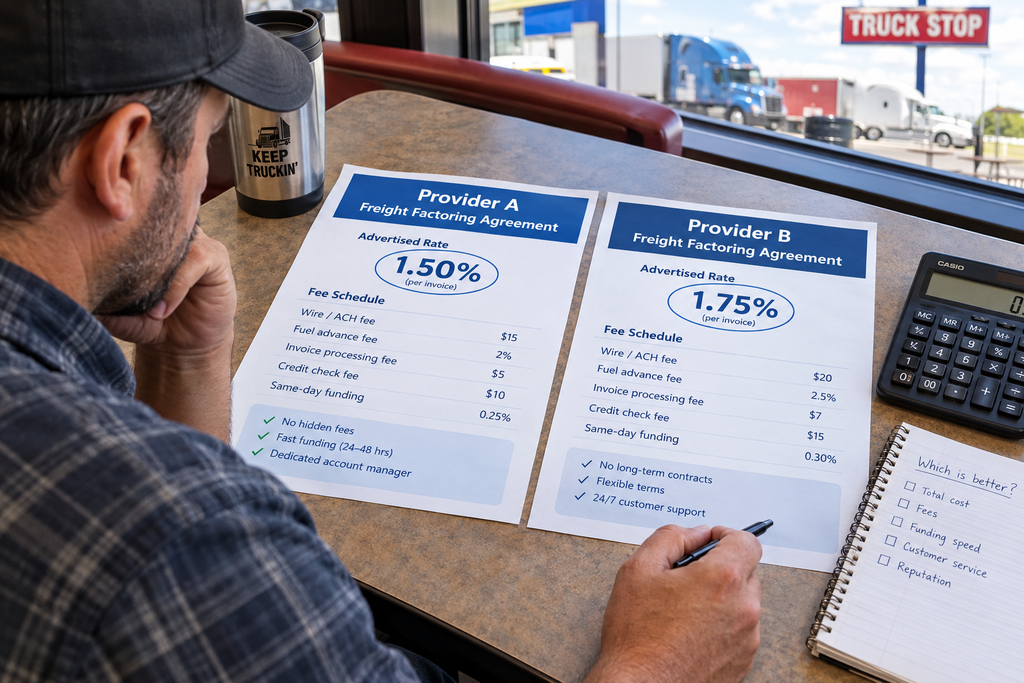
The advance rate and the fee are two different numbers, and the reserve is a third. A factor quoting 2% with a 5% reserve and an 80% advance is not the same deal as a factor quoting 2% flat, even though the headline rate is identical.
Ask when reserve releases, what triggers a hold, and whether reserve on one customer can cover a shortfall on another.
The stack of fees under the headline rate
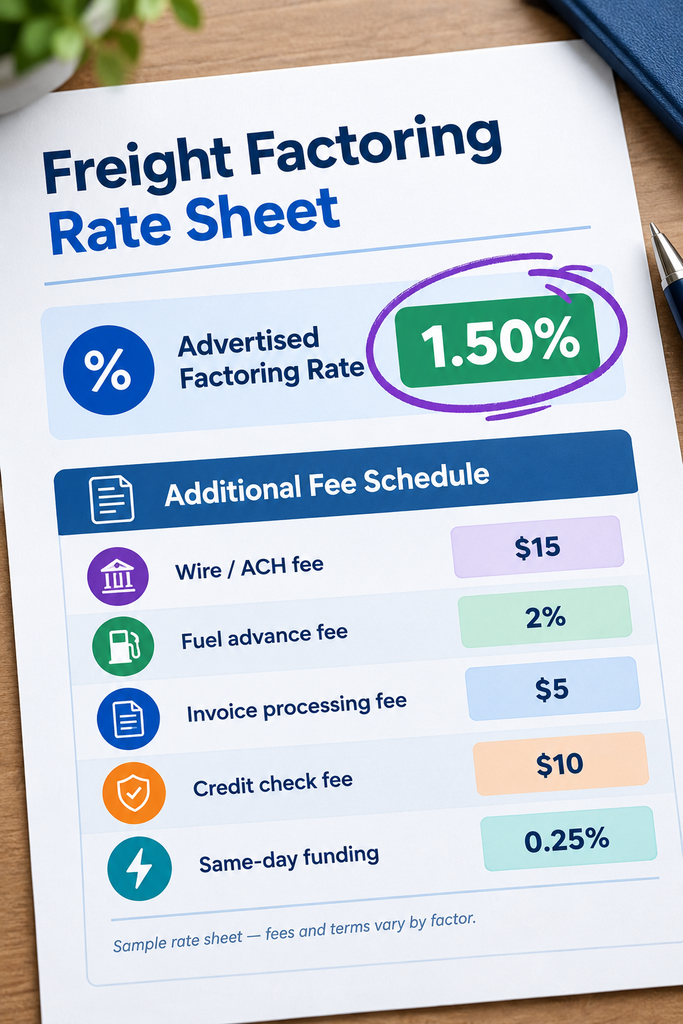
The pattern operators warn about most: a low advertised rate with fees layered underneath it. The ones that show up:
- Setup fees. Over $500 at some factors before a single invoice funds.
- Escrow requirements. Some factors require one. Operators shopping seriously treat “no escrow” as a selection criterion, alongside the rate itself.
- Same-day funding surcharges. The fast pay you signed up for costs extra every time you use it.
- Minimum volume commitments. Agreements that require you to fund a minimum amount of receivables, or to keep funding for a set period, with a charge attached to falling short.
Get the complete fee schedule as a document before you apply, not a number over the phone. Also ask directly about wire and ACH charges each time you move your own money, and about fuel card loading or per-swipe deductions, since those hit per transaction rather than per invoice.
Factoring is not a loan, and that cuts both ways
Nobody is lending you money against your credit. The factor is buying an asset you already own, which is why approval leans on your customer’s creditworthiness more than yours.
That’s the honest case for it. A loan doesn’t check your customers’ credit, process your invoices, or chase payment for you, and factoring does all three. That service has value, and pretending otherwise would be dishonest.
The honest case against it is the math above. At an effective annual cost that operators calculate somewhere between 16% and 24%, factoring is expensive money. It’s worth it when it lets you take loads you otherwise couldn’t cover. It’s a slow bleed when it’s covering a shortfall that never closes.
Recourse and non-recourse, in one paragraph
Under a recourse agreement, if your customer doesn’t pay, you eat the bad debt. Under a non-recourse agreement, the factor is supposed to absorb it. The gap between those two words is worth understanding before you compare offers, because the exceptions written into most non-recourse agreements are wide enough that operators report getting charged back anyway. That’s a whole topic on its own, and it’s covered in the breakdown of what non-recourse really means in a contract.
Before you compare providers, know what you’re comparing
Everything above is how factoring works. What almost no explainer covers is why the same product leaves one carrier better off and another one stuck.
That’s what our report is for. Not All Factoring Is A Payday Loan breaks down the three clauses buried in nearly every factoring agreement, the exact language to look for, and what each one costs you in money and control. Two minute read, no opt-in traps.
Where new carriers get burned
Three patterns account for most of the damage. None of them show up on the rate sheet.
What it does to your credit file
Your factor files a UCC-1 against your receivables. That’s standard, and it’s their collateral. The problem lands later, when you go for an SBA loan or equipment financing and the incoming lender wants a position your factor won’t release. Operators point to exactly that situation, a lien filing plus a factor unwilling to work around it, as the reason they warn others off a company they were otherwise fine with.
There’s a second layer. Factors report payment activity, and their bookkeeping decides what gets reported. Payments that never get applied show up as late payments. Invoices settled inside terms get reported aged 80 or 90 days because someone was emailing a contact who left two years ago. The reported payment date is close to a coin flip, and getting an error corrected runs into internal data nobody outside the company can escalate past.
Ask what gets filed, what gets released at termination, and how long the release takes.
Fees that eat a margin that was already thin
Trucking margins don’t leave much room, and the carriers with the least room are the ones factoring the highest share of their invoices. A quoted rate that looked survivable turns into something else once the reserve, the setup fee, and the per-transaction charges are stacked on it.
The clause language that does this is specific and repeatable, which is why we keep decoded versions of it in our contract fine print database. Knowing the phrasing is most of the defense.
The unscreened operators who gave the industry its reputation
Factoring earned its payday-loan reputation because nobody screens the people selling it.
The contracts that trap you exist. Exclusive terms past 12 months, penalties for leaving early, and agreements that get harder to exit as you grow. Carriers sign, then spend a year telling anyone who asks that they’re leaving the day the term expires, because the exit fee costs more than staying. Some factors build up a book of clients and sell the whole thing, and their clients’ agreements go along with the sale.
The reviews won’t save you either. At least one of the big names pays creators for referrals, so a chunk of the enthusiastic coverage you’ll find is a marketing contract with a friendly face on it.
What Haul Factor screens for
We screen freight factoring companies on behalf of small fleets, and every lender on our bench has to meet the standard we publish as the 4-Point Fleet Shield before we refer a carrier to them.
- 15-Minute Speed-to-Lead SLA. Matched lenders must contact you within 15 minutes or the file auto-reassigns.
- Zero Fuel Card Surcharges. No hidden load fees or per-swipe deductions.
- No Surprise Auto-Renewal. Any renewal terms are disclosed in writing before your first invoice funds.
- Capped Wire & ACH Fees. Flat-rate, transparent transfer costs.
Point two is the one that matters most if you came to factoring for fuel money. A fuel card with loading fees and per-swipe deductions quietly reprices the whole deal, because the cost lands on every transaction rather than on the invoice you were comparing. A lender that breaks one of these after a referral comes off the bench.
Still deciding whether factoring is right for you
The mechanics take five minutes to understand. The agreement takes longer, and that’s where the money is.
When you’re ready to compare actual offers
No rush on this part. Read the report first, get a full fee schedule from anyone you talk to, and put the numbers side by side. When you want to see which lenders would fund a carrier at your stage under terms that pass our screen, the check takes about a minute.
See which factors pass the screen
Factoring is a tool. Used on the right loads with the right agreement, it turns a 60-day wait into same-week fuel money and lets you book freight you’d otherwise have to pass on. Signed without reading, it’s a percentage of every dollar you earn, for as long as the contract runs. The difference isn’t the product. It’s the paperwork underneath it.