

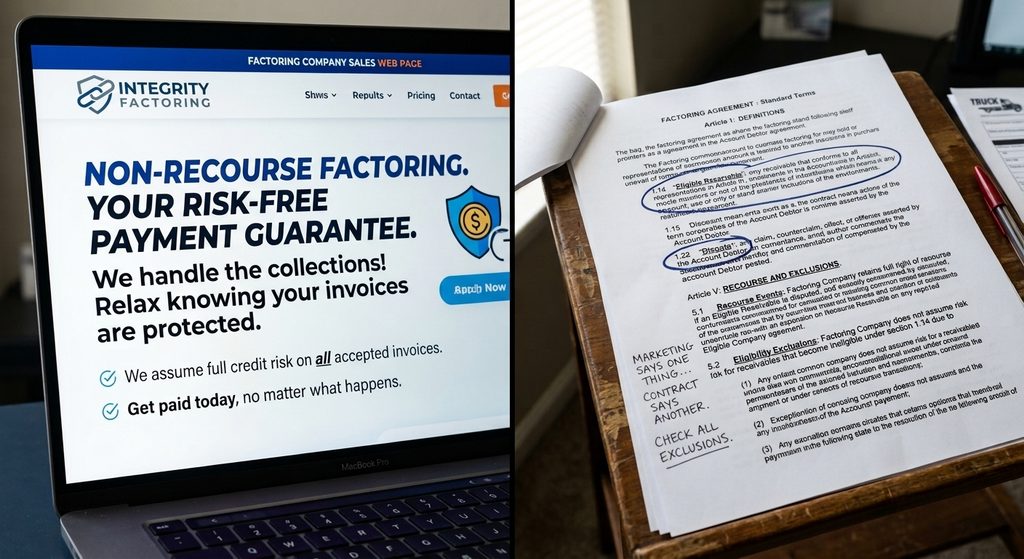
Non-recourse factoring means the factor absorbs the loss when your customer doesn’t pay, and that’s the version you hear on the sales call. The contract usually narrows that promise to one specific kind of nonpayment and routes everything else back to you. Here’s how to test whether the agreement in front of you actually works the way the rep described it.
What the term actually covers
Recourse and non-recourse describe one thing: who eats the bad debt when the invoice never gets paid. Under a recourse agreement, that’s you, stated plainly. Under a non-recourse agreement, the factor takes the credit risk on your customer.
That’s the theory, and it’s the reason operators who have been at this a decade tell newer carriers to sign nothing else.
The practice is messier. Ask around and the same warning comes back: don’t take the recourse-versus-non-recourse conversation at face value, because when the customer doesn’t pay, expect the invoice to land back on you anyway. One operator put it in terms of experience rather than theory, saying the company claimed non-recourse on unpaid loads and never behaved that way. Another framed it as a structural fact: every factor does chargebacks on customers who don’t pay, because none of them are in the business of holding that risk for free.
Both things are true at once. Non-recourse is a real product. It just isn’t “no risk to you.” It’s “no risk to you under a set of conditions the factor wrote and the factor interprets.”
The gap between those two sentences is where the money goes.
Where “non-recourse” quietly stops covering you
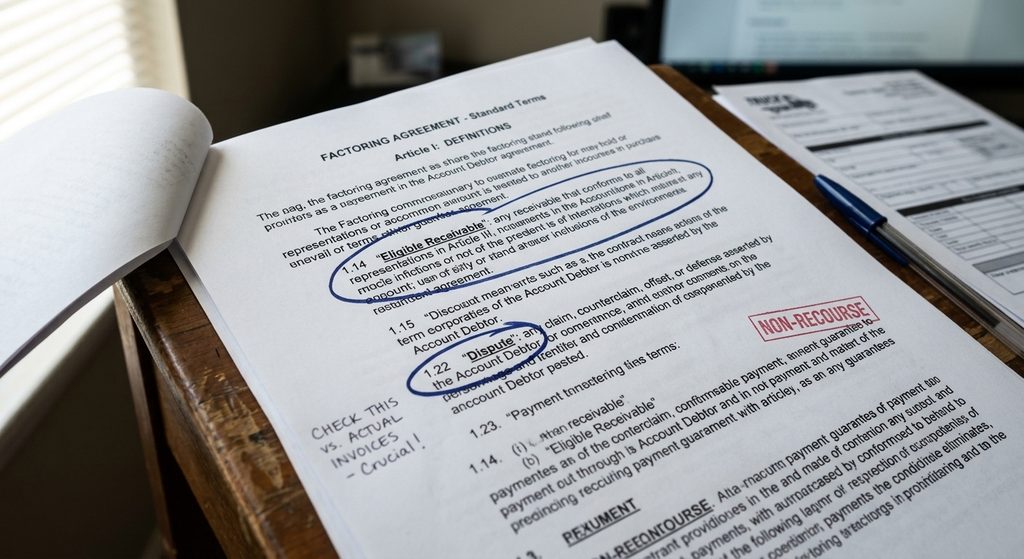
Nobody hides the carve-outs. They sit in the definitions section, three or four pages past the rate everyone reads twice.
The word “disputed” does most of the work
Most non-recourse language covers nonpayment. It does not cover a disputed invoice, and a dispute is whatever the broker says it is. A late delivery, a damaged pallet, a missing signature on the BOL, a rate the broker now claims was different, a tracking penalty written into the rate con. Operators deal with brokers who put a $250 fine on a rate confirmation for missed tracking, then keep emailing about missed tracking after the driver has already sent screenshots of tracking accepted. That fight is between you and the broker. As soon as the word “dispute” is attached to the invoice, the factor’s coverage steps aside and waits.
Paperwork opens the same door. A factor that accepts a submission without checking it can leave the invoice sitting three weeks late in its own system before anyone notices the packet was short a document. If the invoice was never eligible, it was never covered.
Before signing, read the definition of “eligible receivable” and the definition of “dispute” side by side. Those two paragraphs decide more about your risk than the advance rate does. We keep decoded versions of the clauses that show up most in factoring agreements in our contract fine print database, including the language that turns a covered invoice into an uncovered one.
The credit downgrade between booking and delivery
Here’s the sequence that catches people. You check the broker with your factor before booking. Their system says the customer is good to factor. You run the load. By the time it delivers, that broker’s credit rating has moved, and the approval you relied on no longer describes the customer you just hauled for.
Non-recourse coverage almost always attaches to a customer in good standing at the time of funding, not at the time you booked. The downgrade happens inside data you can’t see, on a schedule nobody tells you about.
Ask what happens to an invoice caught in that window. Ask whether the approval you get before booking is binding when the load delivers, and ask for the answer in writing.
Fraud and eligibility clauses the factor gets to define
Freight has a double-brokering problem, and the load boards have their own reasons to keep the churn going, since a re-posted load generates another fee. If a load you hauled in good faith turns out to have been double-brokered, the invoice can be recategorized as fraudulent or ineligible rather than unpaid.
Read who defines fraud in the agreement, and whether that definition requires anything more than the factor’s own determination.
The silence after you sign
The three problems Haul Factor’s second insider report is built around are the ones that show up after the signature: a non-recourse claim that doesn’t get honored, support you can’t reach, and reporting damage you didn’t cause. They arrive in that order.
The chargeback email arrives with no warning
The pattern shows up in operator accounts over and over. A factoring client got an email saying the factor had filed a claim on a broker’s bond, over a load delivered 90 days earlier, with no prior notice that the invoice was even unpaid. Nobody had told them there was a problem. They found out when the factor moved.
Money moves the same way:
- Everything freezes, not just the bad invoice. One fleet had a factor hold all incoming funds until the broker worked out a payment plan, and went days with nothing coming in.
- The wait stretches 30 to 60 days. On defaulted loads, operators sat that long before the factor would set up any alternative route to the money.
- The reserve is where the chargeback comes from. A 2% fee sits alongside a 5% to 6% reserve holdback, and an advance as low as 70% leaves the rest sitting on the factor’s side of the table. When an invoice comes back, that’s the pile it comes out of.
The escalation path that doesn’t exist
When you go looking for someone to reverse the decision, the second problem starts. Back office support sits in another country at some factors. Operators describe being told an issue will be escalated internally, then being told there’s no reason to speak with anyone else, and never reaching a person with authority to make a call. At the biggest names you’re one of thousands of accounts. At the smaller ones, one good account rep is holding the whole relationship together, and people plan to switch factors the day that rep leaves.
Then comes the part that decides the money. One operator described being pushed to accept responsibility for a loss before receiving a complete accounting of it. That’s the real venue where “non-recourse” gets settled. Not the contract — an email thread where the person on the other end has no authority and you have no documentation.
The reporting damage you didn’t cause
Factors feed payment data to the commercial credit bureaus, and the data is only as good as their bookkeeping.
Payments that never get applied get reported as late payments. Invoices paid inside terms show up aged 80 or 90 days because someone was emailing a two-year-old AP contact. The reported payment date is a coin flip. Getting it corrected runs into the same wall as everything else, which is that the data is internal and there’s nobody to escalate to.
That matters to you for a reason beyond fairness. The ratings those systems produce are the same ratings your factor uses to decide which brokers are good to factor. A customer downgraded on bad data is a customer whose invoices stop being covered, which puts you right back at the carve-out.
The three clauses to find before you sign
If there’s an agreement in your inbox labeled non-recourse, you don’t need to read all 14 pages tonight. You need to find three specific clauses and read what they actually say.
That’s what our report does. The Silence After You Sign breaks down the three clauses buried in nearly every factoring agreement, the exact language to look for, and what each one costs you in money and control once the account is live. Two minute read, no opt-in traps.
Five questions to ask before you accept a non-recourse offer
Send these by email so the answers exist in writing. A rep who will say it on the phone and not in an email has told you something.
- What exactly triggers coverage? Customer insolvency only, a formal bankruptcy filing, or any nonpayment past a set number of days? These are three different products sold under one word.
- Who decides an invoice is disputed, and what happens next? Ask whether the broker’s word alone moves the invoice out of coverage, and what you have to prove to move it back in.
- How long after funding can you charge an invoice back, and where does the money come from? Ask specifically whether it can be pulled from a different customer’s payment or from your reserve.
- What notice do I get before you act? Before contacting your customer, filing on a bond, or reversing funding, ask what you’re told and when.
- What happens if you approve a customer before pickup and downgrade them before delivery? The answer to this one separates factors who stand behind an approval from factors who treat it as a snapshot.
Two more things worth doing. Run the whole agreement through an AI tool and have it list every fee, every carve-out, and every notice deadline as a single list. Then put the definitions section in front of an attorney, because that’s where the coverage actually lives. If you’re in your first two years of authority, the terms tend to come back harder still, which is worth reading up on before you compare offers.
What Haul Factor screens for
We screen freight factoring companies on behalf of small fleets, and every lender on our bench has to meet the standard we publish as the 4-Point Fleet Shield before we refer a carrier to them.
- 15-Minute Speed-to-Lead SLA. Matched lenders must contact you within 15 minutes or the file auto-reassigns.
- Zero Fuel Card Surcharges. No hidden load fees or per-swipe deductions.
- No Surprise Auto-Renewal. Any renewal terms are disclosed in writing before your first invoice funds.
- Capped Wire & ACH Fees. Flat-rate, transparent transfer costs.
The first point is the one that speaks to this topic. A factor that answers inside 15 minutes when it wants your business is a factor you can hold to a standard when an invoice goes sideways, which is the only moment the word non-recourse gets tested. A lender that breaks one of these after a referral comes off the bench.

Before you sign something labeled non-recourse
The exclusions are already in the agreement, and they don’t change based on how the call went. Find the three clauses first.
When you’re ready to compare actual offers
No rush. Read the report, send the five questions, and see which factor answers all of them in writing. When you want to see which lenders would fund a carrier at your stage under terms that pass our screen, the check takes about a minute.
See which factors pass the screen
Non-recourse is worth having when the contract behind it is real. The way to find out is to read the definitions before you sign, ask the five questions while you still have leverage, and keep the answers where you can find them later. The operators who got burned all describe the same moment: the first time they needed the clause, nobody would tell them what it meant.